Introduction
What Gally is in two minutes — pool USDC, fund real projects, hold a yield-paying digital deed — and where to go next.
Gally is a decentralized capital protocol on the Sui blockchain. It lets ordinary people pool USDC to fund vetted real-world projects — housing, machinery, trade finance, agriculture, energy, infrastructure — and in return hold a digital deed that pays out the project's yield. The deed is a real object in your own wallet, not a balance on someone else's spreadsheet.
If you have two minutes, this page is the whole idea. If you want to do something, jump to Getting Started.
The problem Gally solves
Real-world-asset (RWA) yield has always been closed to retail investors. The deals are large, they are illiquid, and they require you to trust an operator to actually pay you back. Gally removes, collateralizes, or legally binds every one of those trust assumptions. It tackles two long-standing problems at once:
- The trust paradox — how can on-chain money trust an off-chain business? Every asset is bound by a Smart Trust — a legally binding, court-enforceable contract — and a network of validators stake hard collateral to vouch for its legal strength and keep it compliant. Vouch for something false and they're slashed and you're compensated. Trust shifts from the operator's goodwill to staked capital plus a real legal contract.
- The liquidity paradox — how does a custom yield-bearing asset work with normal DeFi? Gally lets you wrap your deed into a plain, fully tradable coin whenever you want liquidity, and unwrap it back when you want yield again.
The "Two Triangles"
Gally balances community capital against strict enforcement using two complementary halves:
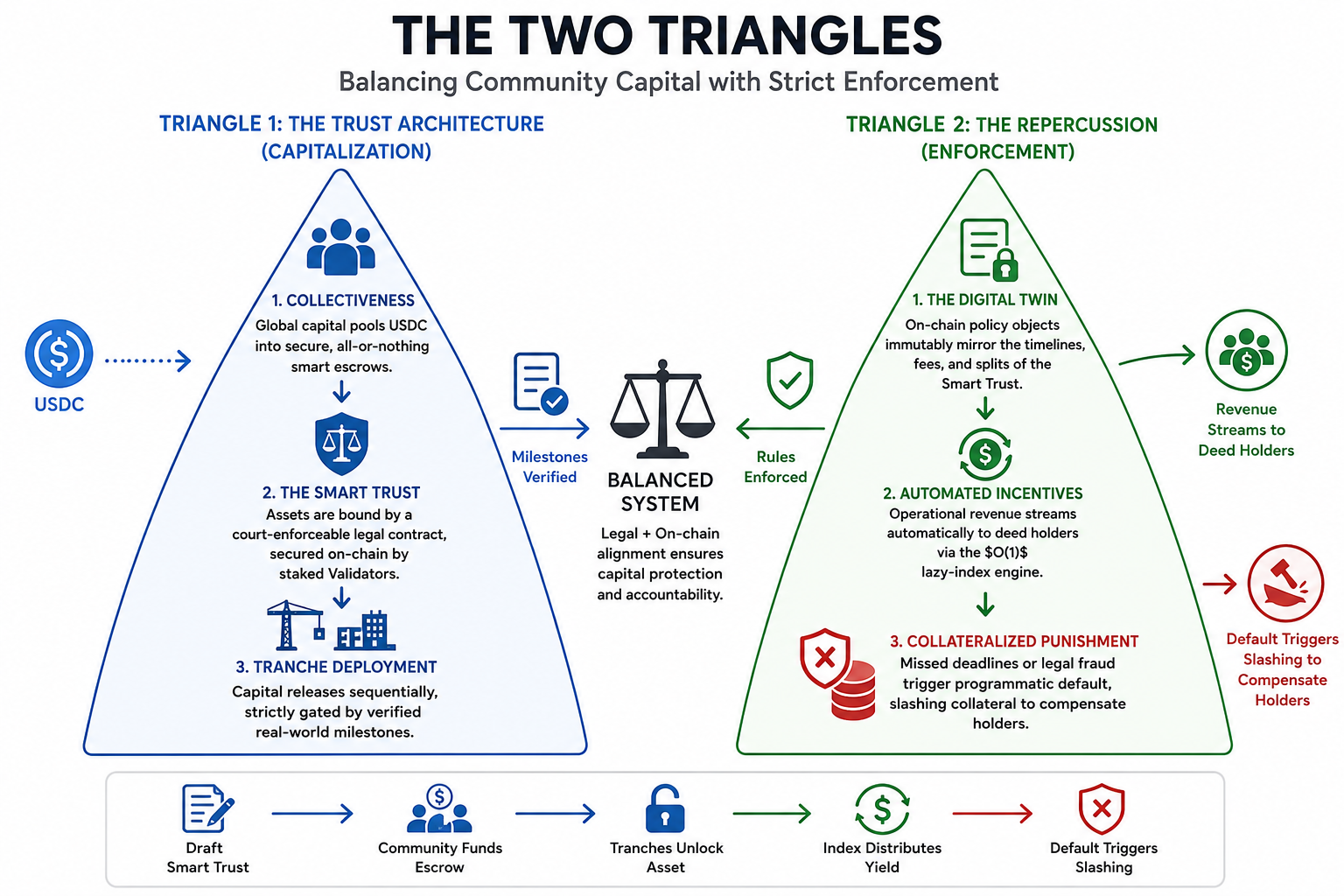
- Triangle 1 — Community (capital formation). Many people pool small amounts of USDC into a shared on-chain escrow. Trust is placed in the smart contract and the asset's legally binding Smart Trust — not the operator's goodwill. Money is released only as real milestones are met.
- Triangle 2 — Repercussion (governance & enforcement). Rules fix the timeline, the revenue split, and the fees. Revenue is streamed automatically to deed-holders. And anyone who fails their obligations — a builder who misses a deadline, a validator who vouches for a fraud — has their staked collateral slashed to compensate investors.
The four people in the system
| Role | What they do |
|---|---|
| Investor | Pools USDC, receives a deed, claims yield, can wrap for liquidity, and can always exit. |
| Entity (builder / business) | Operates the real asset under a legally binding Smart Trust; unlocks funding only as validator-approved milestones are met; posts its own collateral. |
| Validator | A decentralized legal oracle — stakes USDC to vouch for the asset's Smart Trust (its legal strength & compliance) and to approve milestones. Slashed if the legal reality stops matching the tokens. |
| Challenger | Anyone who spots fraud and posts a bond to open a dispute. |
The trust thesis, in one line
**You don't blindly trust the operator — you trust a validator who has staked real capital to vouch for the asset's legally binding Smart Trust, backed by an admin trusted only with parameters, never with your money.**
This is a dual-layer model. On-chain, your capital is mathematically safe — every place it sits at risk has a permissionless exit that can never be paused (refund, claim, unwrap, redeem). Off-chain, the Smart Trust makes the real-world asset legally enforceable, so the tokens are backed by a defensible reality, not a promise.
How to read these docs
The docs are organized in four parts. Press / or ⌘K anywhere to search.
- Understand — the concepts, the Smart Trust legal layer, the lifecycle, the economic model, and the trust & security model. Start here to learn how it works.
- Use — getting started, step-by-step guides for investors and challengers, the explorer tour, and six worked examples. Read this to learn what to do.
- Build & Operate — the system architecture and how to run it.
- Reference — the FAQ, glossary, and parameters.
New here and just want to invest? Read Core Concepts, then go straight to Getting Started.